Running a childcare center means managing one of the most challenging infection control environments that exists. You have a population that puts everything in their mouths, cannot consistently wash their hands without supervision, shares toys and surfaces continuously, and whose immune systems are still developing. You also have regulatory requirements that govern how you clean, what products you use, and how you document it. Getting disinfection right in a childcare setting is not simply a matter of spraying surfaces and wiping them down. It requires a program that is simultaneously effective against the pathogens circulating among young children, safe for the bodies those children have, and defensible under the scrutiny of licensing inspections and parent expectations.
Why Childcare Disinfection Is a Different Problem From Standard Institutional Cleaning
The instinct when building a childcare cleaning program is to start from institutional cleaning standards and work backwards toward something appropriate for children. That approach consistently produces programs that are either too harsh for the environment or too mild to satisfy regulatory requirements, because childcare is genuinely a distinct category that does not map neatly onto either clinical or commercial cleaning standards.
The distinction starts with exposure pathways. In most institutional environments, the primary concern is hand-to-surface-to-hand transfer and airborne transmission. In childcare, you add direct oral contact with surfaces and objects as a primary pathway. Infants and toddlers mouth toys, chew on furniture edges, press their faces against soft furnishings, and crawl on floors that other children have just been on. This means that chemical residue left on surfaces after disinfection is not a theoretical concern but a near-certainty, and the toxicity profile of that residue matters in a way it does not in most other cleaning contexts.
The pathogens circulating in childcare settings are also partly different from those that drive infection control priorities in healthcare. Respiratory syncytial virus, rotavirus, hand foot and mouth disease caused by coxsackievirus, Giardia, and pinworm are common in childcare settings and less prominent in typical adult institutional environments. Any disinfection program built around pathogen kill claims needs to verify those claims against the organisms that actually drive illness in the population it serves, not just the organisms that appear most prominently on general-purpose disinfectant labels.
Regulatory oversight is a third dimension that sets childcare apart. State childcare licensing regulations in most jurisdictions specify requirements for cleaning and disinfection that go beyond the general workplace safety standards that govern other institutional settings. These requirements address product types, surface-specific protocols, documentation standards, and in some states the specific chemical categories that may or may not be used in childcare facilities. A disinfection program that satisfies general institutional standards may not satisfy the childcare licensing requirements in your state.
What Are the Regulatory Requirements That Childcare Facilities Actually Need to Meet?
Childcare licensing in the United States is administered at the state level, which means there is no single national standard that covers all facilities. What there is, however, is a consistent set of themes that appear across state regulations and that any childcare disinfection program must address regardless of jurisdiction.
The most universal requirement is that cleaning and disinfecting products must be stored separately from food and out of reach of children. This seems obvious but has specific implications for how products are kept during the school day, when staff are moving between cleaning tasks and child supervision, and for how supplies are managed in rooms that children access freely.
Most state childcare regulations distinguish between cleaning, which removes visible soil and organic material, and disinfecting, which kills pathogens on a surface that has already been cleaned. The requirement to clean before disinfecting is explicit in most licensing frameworks and has practical implications for product selection and protocol design. A product that claims to clean and disinfect simultaneously may not satisfy the regulatory requirement for a two-step process in states where those steps are specifically mandated.
Product safety requirements vary by state but commonly include restrictions on bleach concentrations used in rooms occupied by children, requirements that products be used only as directed on their EPA-registered label, and in some states explicit restrictions on the use of certain chemical categories including high-concentration quaternary ammonium compounds and formaldehyde-releasing agents in child-occupied spaces. Several states reference the EPA's Safer Choice program or equivalent third-party safety certifications as guidance for product selection in childcare environments.
Documentation requirements are among the most commonly cited deficiencies in childcare licensing inspections. Most states require that cleaning and disinfection schedules be written, posted, and followed, that products in use be documented by name, and that safety data sheets be available for all cleaning products on site. Some states require that staff receive documented training on cleaning product use and safety before being permitted to perform cleaning duties.
The federal Head Start Program Performance Standards, which govern federally funded early childhood programs, add another layer of specificity. These standards require that facilities maintain written sanitation policies, use EPA-registered disinfectants, follow manufacturer directions for use including contact times, and document disinfection of specific surface categories on defined schedules. Facilities operating under Head Start standards have the most detailed regulatory requirements to satisfy, and their disinfection program design needs to reflect that.
What Product Criteria Actually Matter for Childcare Disinfection?
Given the regulatory landscape and the specific exposure realities of childcare environments, product selection for childcare disinfection should be evaluated against a more specific set of criteria than those used for general institutional purchasing.
EPA registration is the non-negotiable baseline. Any product used for surface disinfection in a childcare facility must carry EPA registration, which means its kill claims have been independently tested and verified under FIFRA. Products that claim to be antibacterial or sanitizing without an EPA registration number have not met this standard and should not be used in any regulated childcare environment.
The active ingredient matters more in childcare than in most other settings because of the oral exposure pathway. Benzalkonium chloride at the concentrations used in consumer and institutional disinfecting wipes, 0.1% to 0.3%, has a substantially lower toxicity profile than bleach or high-concentration alcohol when incidental oral contact occurs, which is the relevant scenario when infants and toddlers put recently disinfected surfaces in their mouths before the surface has fully dried. BZK is used in wound care, baby care products, and oral health products at concentrations comparable to those in disinfecting wipes, which speaks to its established safety profile for contact with young children.
Bleach-based products present specific concerns in childcare environments beyond general toxicity. The chlorine vapor produced by bleach application in enclosed rooms is a respiratory irritant that is disproportionately significant for young children whose respiratory systems are still developing and who breathe proportionally more air relative to their body weight than adults. Regulations in several states specifically restrict bleach concentrations in child-occupied spaces for this reason, and some state licensing frameworks require enhanced ventilation when bleach-based products are used in areas occupied by children.
Fragrance is a concern in childcare settings for two overlapping reasons. Fragrance compounds are among the most common contact allergens in children, and a significant proportion of childhood contact dermatitis cases are attributable to fragrance exposure through cleaning products used on surfaces children contact directly. Fragrance also contributes to indoor air quality concerns in the enclosed environments of childcare rooms, where small space volumes and limited ventilation allow airborne chemical concentrations to build more readily than in larger commercial spaces.
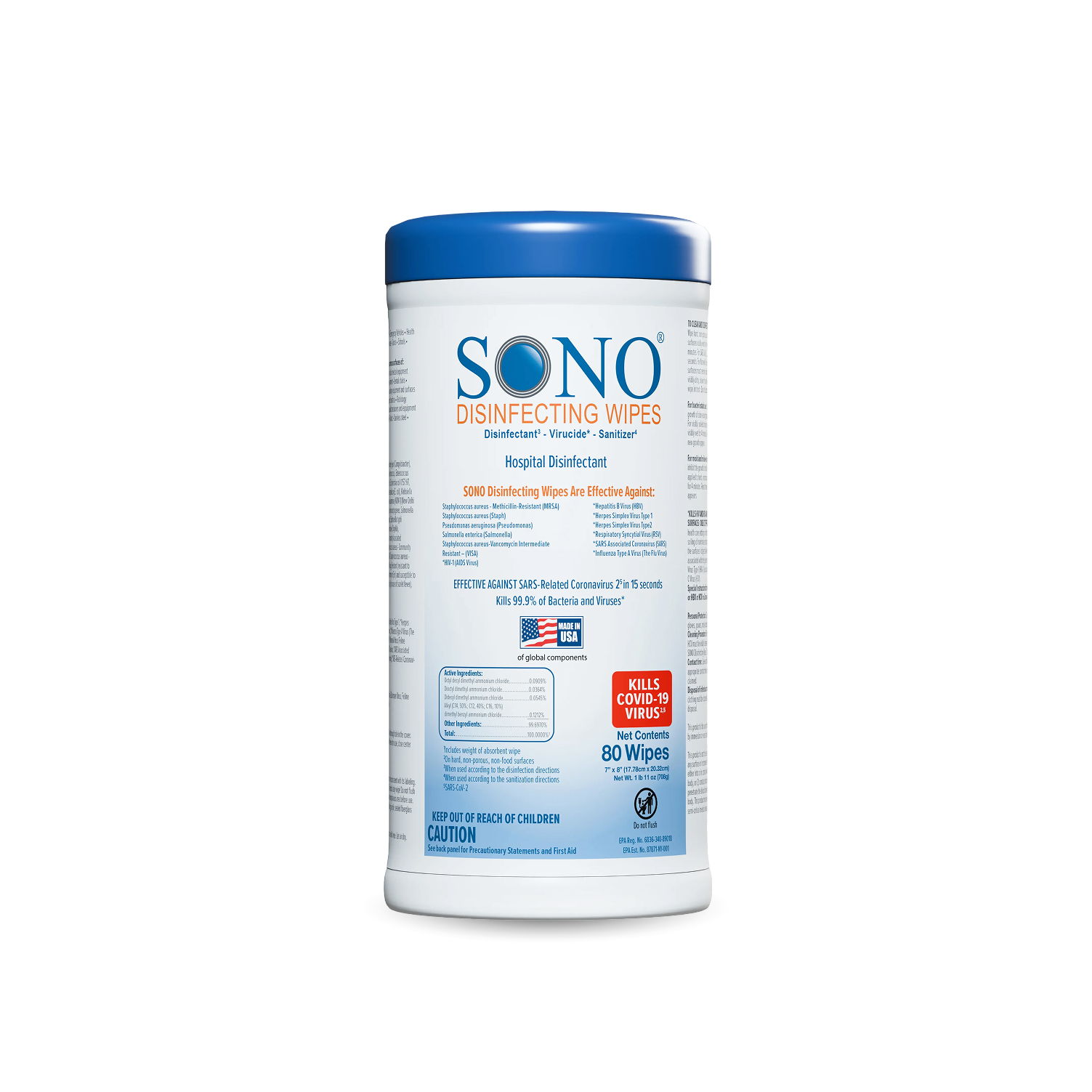
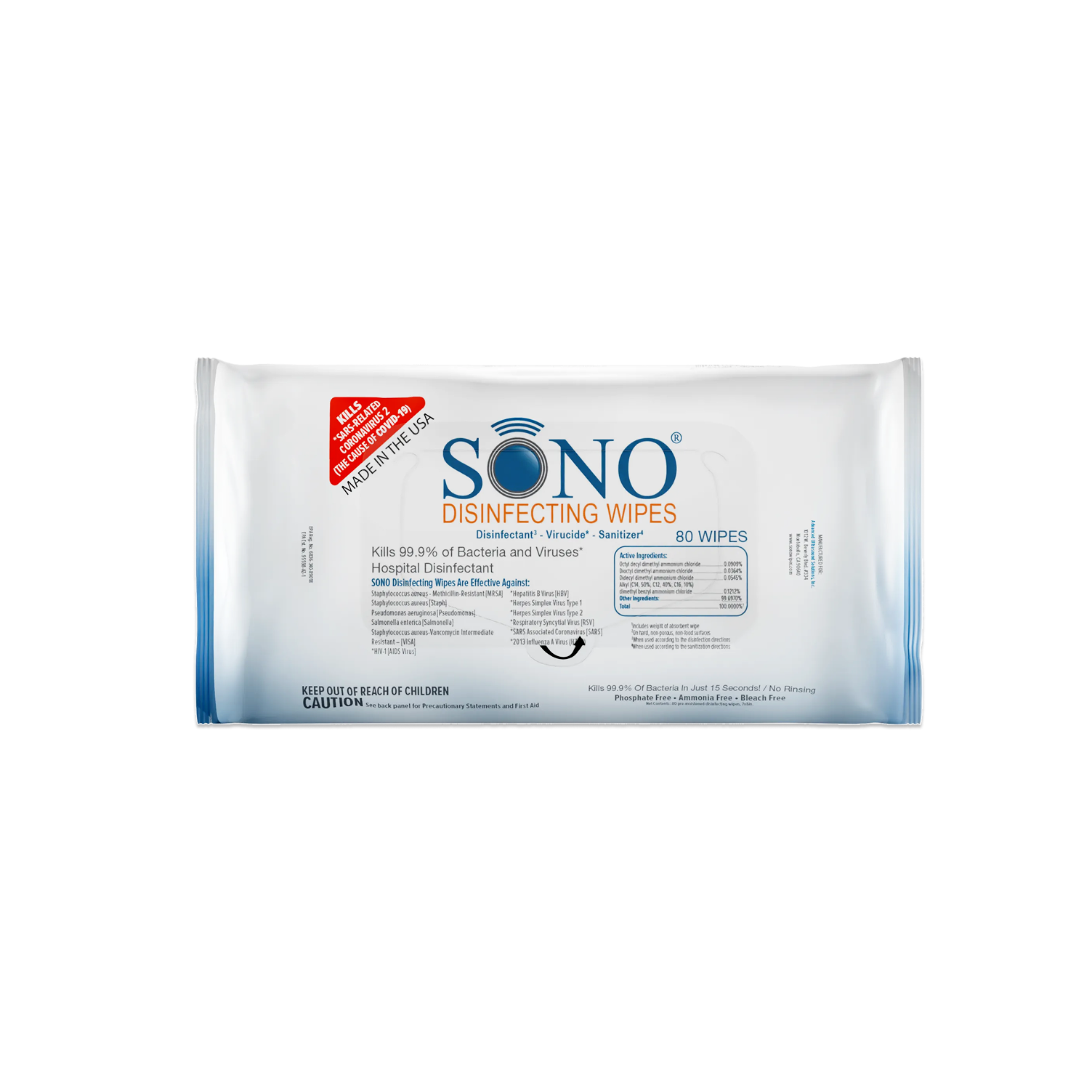
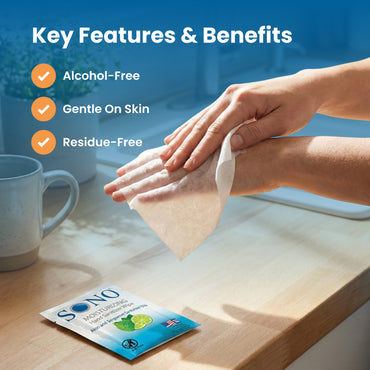
SONO Supplies' alcohol-free, bleach-free, fragrance-free disinfecting wipes meet the product criteria most relevant to childcare settings. The BZK active ingredient provides EPA-registered kill efficacy against the pathogens relevant to childcare environments, including Norovirus, Rotavirus, MRSA, E. coli, and Influenza A, without the chemical hazard profile that makes bleach and alcohol products problematic in child-occupied spaces.
How Should Hard Surfaces, Toys, and Soft Furnishings Be Handled Differently?
One of the most common gaps in childcare disinfection programs is treating all surfaces and objects as if they require the same approach. They do not, and the differences matter both for efficacy and for compliance.
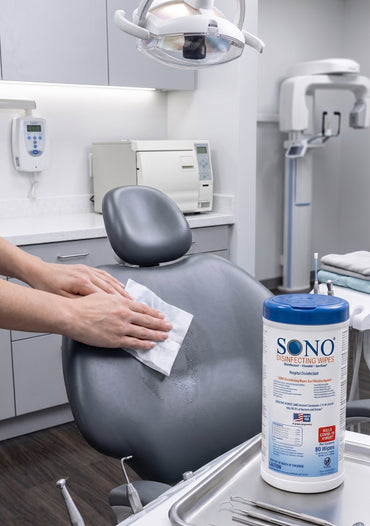
Hard, non-porous surfaces are the category for which disinfecting wipes are the appropriate primary tool. Diaper changing tables, high chair trays, door handles, light switches, cabinet pulls, bathroom surfaces, and the hard plastic components of toys all fall into this category. For these surfaces, the protocol is straightforward: clean visible soil first if present, apply the disinfecting wipe and allow the required contact time to complete before the surface is touched again or put back into use. Contact time compliance is as important in childcare as in any clinical setting, and protocols should specify that surfaces remain wet for the full contact time, typically one minute for BZK-based products, before being considered disinfected.
Toys present a more complex challenge because they vary in material, size, and the nature of the contact children have with them. Hard plastic toys that are mouthed regularly are the highest disinfection priority and the most straightforward to address. They should be disinfected between uses by different children when practical, and at minimum at the end of each day. For high-volume settings where individual toy tracking between children is not feasible, a clear rotation system where toys are set aside for disinfection after use and returned to circulation only after the contact time has been completed is the practical standard.
Water table toys and items used in sensory play that involve water or wet materials present specific contamination risks because the water itself can harbor pathogens if not changed and the container disinfected frequently. Daily emptying and disinfection of water play containers and the items used in them is the appropriate standard.
Fabric and soft toys cannot be effectively disinfected with surface wipes, and this is a point that many childcare programs handle inconsistently. The correct approach for soft toys is regular laundering at temperatures sufficient to kill the relevant pathogens, which for most common childcare pathogens means a hot water wash cycle. Soft toys that cannot be laundered should be limited in high-contact childcare environments or designated for single-child use.
Soft furnishings including fabric-covered nap mats, upholstered seating, and area rugs are similarly outside the scope of wipe disinfection. Nap mats should be assigned to individual children, cleaned where the material allows, or laundered at appropriate intervals. Area rugs in infant and toddler rooms should be washable and laundered on a defined schedule. Upholstered seating in child-accessible areas should either be limited or covered with materials that can be wiped.
Floors deserve more attention than most childcare disinfection programs give them. Infants and young toddlers spend significant time on floors, and floor surfaces carry contamination from outdoor shoes, crawling contact, and spills throughout the day. A daily floor disinfection cycle using an EPA-registered product appropriate for the floor material is a standard that most state licensing frameworks either specify or imply.
What Does Staff Training Need to Cover for a Compliant Program?
A disinfection program is only as effective as the staff implementing it, and childcare staff turnover rates, which are among the highest of any industry sector, mean that training is a continuous process rather than a one-time event. The training content that matters most for childcare disinfection compliance covers five areas.
Product identity and safety is the first area. Every staff member performing cleaning duties should know the name of every product they are using, where the safety data sheet for that product is located, what the product's active ingredient is, and what to do if a child contacts the product directly or if a spill or mixing incident occurs. This is not detailed toxicology training. It is baseline product literacy that takes fifteen minutes to establish and that is required by most state licensing frameworks.
The distinction between cleaning and disinfecting is the second area. Staff who conflate these two steps or who believe that a visibly clean surface is a disinfected one will not implement the two-step protocol correctly regardless of how well the written program is designed. Training needs to make the distinction concrete and explain why it matters in terms that translate to daily practice.
Contact time is the third area and the one most frequently compromised in busy childcare settings. Staff need to understand that the contact time is not optional and that a surface wiped and immediately touched again has not been disinfected. Practical strategies for building contact time into the workflow, using a timer, working through a sequence of surfaces so that each has time to dwell while others are being wiped, are more effective than abstract instruction to wait the required time.
Surface category recognition is the fourth area. Staff should be able to identify which surfaces and objects in their room require disinfection versus cleaning only, which items require laundering rather than wiping, and which items are not appropriate for disinfection with the products in use. A simple laminated reference card posted in each room that lists surface categories and the appropriate protocol for each is the most practical implementation of this training.
Documentation is the fifth area. Most childcare licensing frameworks require that disinfection activities be logged, including what was cleaned, when, and with what product. Staff who understand why documentation matters are more likely to maintain accurate records than those who experience it as administrative burden without context.
How Do You Build Documentation That Satisfies Licensing Inspections?
Documentation for childcare disinfection compliance does not need to be elaborate, but it does need to be complete, consistent, and readily accessible during an inspection. The core documentation components that satisfy most state licensing requirements are a written cleaning and disinfection policy, posted schedules, cleaning logs, product records, and staff training records.
The written policy should specify the products in use by name and EPA registration number, the surfaces and objects covered by the program, the frequency of cleaning and disinfection for each surface category, the contact time required for each product, the storage protocol for cleaning products, and the procedure for handling a situation where a child contacts a cleaning product directly.
Posted schedules translate the written policy into the daily practice that staff follow. A posted schedule in each room listing the cleaning and disinfection tasks assigned to that room, when they occur, and who is responsible provides the operational guidance that staff need and the visible evidence of program structure that inspectors look for.
Cleaning logs are the daily record that the program is being implemented. A simple log that records the date, the surfaces or objects cleaned and disinfected, the product used, and the initials of the staff member performing the work satisfies the documentation requirement in most jurisdictions and takes under two minutes to complete at the end of each cleaning cycle.
Product records should include the current safety data sheet for every product in use, the EPA registration number for every disinfecting product, and the product label or a copy of the approved label at the time of purchase.
Training records document that each staff member has received instruction on the cleaning products and protocols in use. A simple sign-off sheet dated at the time of training and kept in the personnel file for each staff member satisfies this requirement in most jurisdictions.
Frequently Asked Questions
What is the correct dilution for bleach when it is used in childcare settings?
When bleach is used in childcare settings, the CDC and most state licensing frameworks specify a dilution of one tablespoon of unscented liquid chlorine bleach per gallon of water for sanitizing non-porous surfaces, and a dilution of one quarter cup per gallon for disinfecting surfaces contaminated with bodily fluids. These dilutions reduce but do not eliminate the respiratory and skin irritation concerns associated with bleach in child-occupied spaces. The one-tablespoon dilution also has limited efficacy against non-enveloped viruses including Norovirus at the contact times practical in childcare settings. For facilities seeking bleach-free alternatives with comparable or broader kill spectrum, EPA-registered BZK-based disinfecting wipes provide Norovirus kill at a one-minute contact time without the respiratory concerns that accompany even diluted bleach in enclosed spaces with young children.
How do you handle disinfection during an active illness outbreak in a childcare center?
During an active outbreak, the frequency of disinfection for high-touch surfaces and toys should increase to as close to continuous as staffing allows, with a minimum of disinfection after each use by each child for mouthed toys and high-contact surfaces. The specific pathogens involved in the outbreak should inform product selection verification. For Norovirus outbreaks, which are among the most common outbreak scenarios in childcare settings, confirm that the product in use carries a specific Norovirus kill claim, as not all EPA-registered disinfectants cover this pathogen. For Hand Foot and Mouth outbreaks caused by coxsackievirus, verify that the product covers non-enveloped enteroviruses. Notification of the relevant state health department is required in most jurisdictions when an outbreak of a reportable illness occurs in a licensed childcare facility.
Are there specific toys or materials that should not be in infant and toddler rooms because they cannot be safely disinfected?
Yes. Fabric stuffed animals and plush toys that cannot be laundered at appropriate temperatures, items with small pieces that create choking hazards, items made from materials that degrade significantly with repeated disinfection, and any items with crevices or joints that cannot be reached with a wipe are all candidates for exclusion from infant and toddler rooms. Most early childhood education specialists recommend that toys in infant and toddler rooms be limited to items that can be either wiped with a disinfecting product or laundered in a washing machine. Sand and sensory materials shared between children present specific contamination management challenges and should be governed by explicit protocols covering replacement frequency, container disinfection, and exclusion of visibly ill children from sensory play.
How do you communicate your disinfection program to parents in a way that builds confidence?
Parent communication about disinfection is most effective when it is specific rather than general. A posted summary of the products used in the facility, their safety certifications, and the specific pathogens they are registered to kill communicates more credibly than a general statement about commitment to cleanliness. Including the EPA registration number for your disinfecting products and noting any third-party safety certifications such as EPA Safer Choice demonstrates that product selection was deliberate. During illness season or following a facility-wide illness event, proactive communication that describes the specific enhanced disinfection steps the facility is taking, which surfaces are being disinfected more frequently and with what product, is significantly more reassuring to parents than a general notice that the facility is being cleaned.